How Can I Build A (Working) Marketing Funnel For My Service?
Rita Obaze
12/15/202512 min read
Piecing together a marketing funnel (when all you’re trying to do is sell your service) can seem pretty daunting to do yourself. If you’re reading this, then you’ve probably already heard that you really need to “build a funnel” for your service. But rather annoyingly, no one gave you a clear answer to “What goes first?”
For some of you reading this, you’ve already tried to start this out on your own. But you ran into this issue of piecing everything together. Everyone says "build a funnel," but no one gives you a realistic, step-by-step assembly manual for a service. Should you focus on content? Build a landing page? Get the email system running?
Today, we’re going to demystify the entire funnel-building process so that you can finally have a clean, reliable path that takes a curious stranger visiting your site and turns them into a confident, paying client.
Start Your Service’s Marketing Funnel Like This…
Instead of starting with a tool (like an email system) or a tactic (like posting content), it is so much easier to get the core framework down first. So, right now, we’re not building a whole machine; we’re just setting up a predictable client journey. And you can - and should - do it while holding off buying any tool.
Before we continue, you may want to put aside everything you already know about funnels (and their many moving parts) for a second. All of that WILL come in handy, but it is can be so much easier to plan out your funnel without trying to piece together all those marketing bits simultaneously.
So, where do you start?
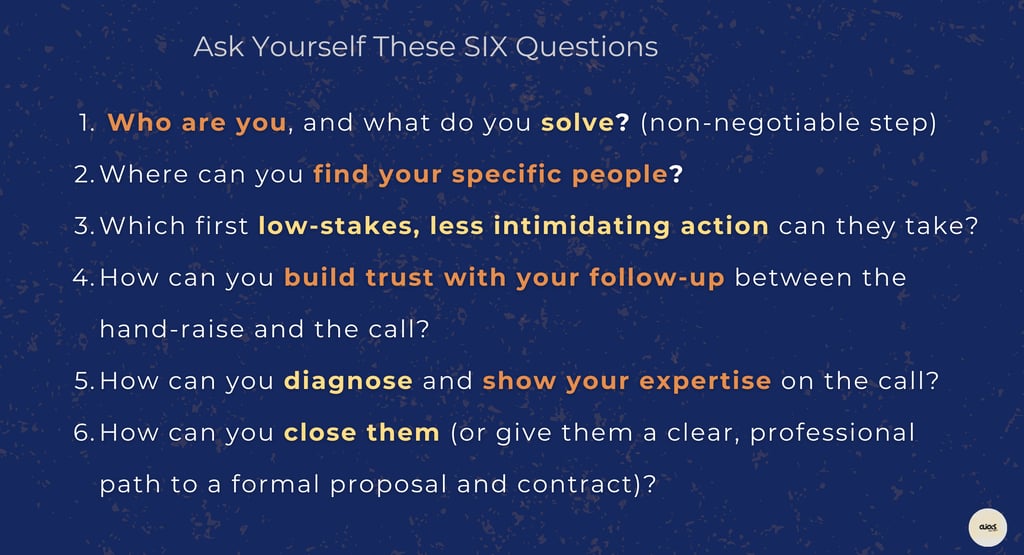
1. Get Your Stance Very VERY Clear:
Before you lift a finger, you must nail this: What’s the clear promise you are making? a statement that says, "I help [Specific Human] achieve this [Specific Outcome]." If this is muddy, every step that follows will fail. Let’s call this concept, ‘The One Thing’.
This seems like a pretty trivial thing, but it can make a world of difference. In fact, getting clear in marketing is so important that every copywriter, established business, investor, and marketer (big and small) requires all services businesses to know who, what, why, and how you’re selling. Copywriters call it the RIOA?
RIOA?
Reader: If you were talking to one person (your ideal reader) about your service, who would that be? Which problem do they have and what’s stopping them from buying? What is it about your brand that makes you the perfect fit for them?
Idea: What would you tell them? If you could tell them just one thing (like in an elevator pitch), what would it be?
Offer: What are you offering this one person? Does it solve their problem, really? And is it a no-brainer for them, or do they have some objections that may keep them from ordering your service?
Action: If you could get this reader to do just one thing at that time that you’re talking to them, what would it be?
When you’re really clear on these things, getting the rest of the funnel right becomes SO much easier.
2. One Place to Show Up:
Stop trying to be everywhere for now. Being everywhere is great, especially in our post-AI, “Search Everywhere Optimization” era, but right now, just pick one channel. That One Reader from earlier…where does he hang out? Are you most likely to find them up on LinkedIn, or a specific industry forum, or on a complementary service’s email list? Where are your clients, and where do they actually spend time? Find that one place and find a way to add value to that one reader…consistently.
3. Design the "Hand-Raise":
How does someone go from watching you (Step 2) to signaling interest? This part should be a simple ‘invitation’ of sorts that lets them know…
“Hey, so you clicked that last thing, and you got a lot of value from it. But this next thing, woof! You really might want to check that one out next.” Just bear in mind that you don’t want to make big asks right away. You’ll probably see more success if you go for a direct, low-commitment ask that guides them to the next step.
4. The Immediate Response:
Once they take the Hand-Raise, you need an instant, human response ready to go. You’d never leave a client hanging in person, so don't do it here. It is mind-blowing how many services lose leads to this simple follow-up challenge. And so many businesses that have existing funnels focus on making sure that they are constantly in touch with their leads and are giving them the most helpful (and most relevant) feedback.
5. Master the Final Chat:
The end of the funnel is the sales conversation. You need a framework that ensures you know exactly how to run this conversation from introduction to outcome, every single time.
If you really, REALLY want to simplify things;
The simplest working funnel has just three core components:
traffic (where people find you) + offer (what you're saying) + follow-up (how you stay in touch)
The 3 Things Services NEED For A Good Customer Journey Experience
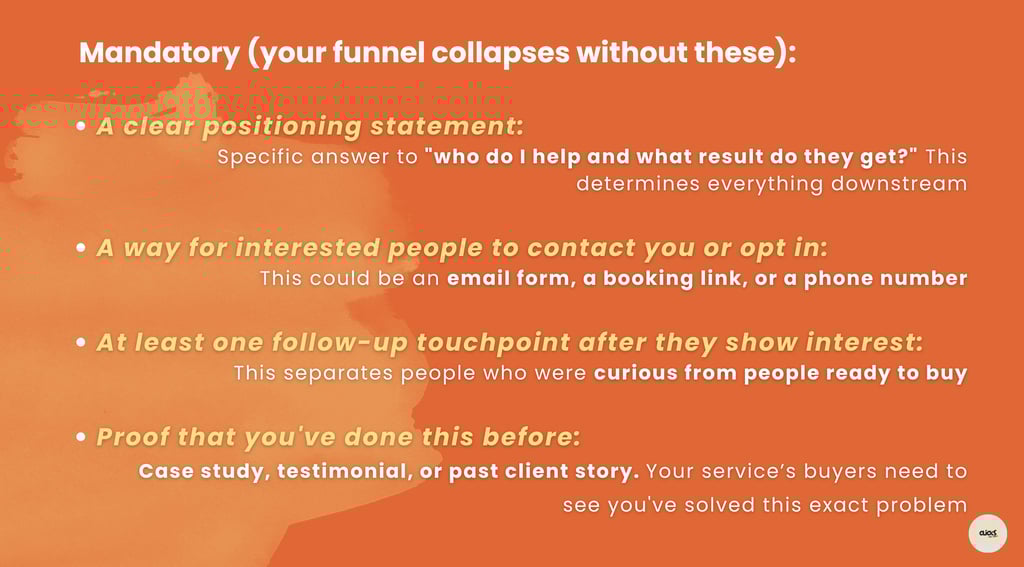
clarity on who you help.
one clear way for them to reach you.
and consistent follow-up when they do.
Service Business Marketing Funnels
(Is it any different from e-commerce funnels?)
It’s important to point this part out. There can be several differences between your ideal funnel and that of most product-based businesses. You may not have realized this until now, but a lot of the funnel advice out on the internet is borrowed directly from e-commerce and SaaS (Software as a Service). Those businesses have a clean, instant transaction. Their entire goal is to get the prospect from a product page to a checkout button as fast as possible. The funnel ends at the credit card swipe.
But your service funnel doesn’t work like that.
For you, the “conversion” is not an instant payment. It's the moment a prospect feels enough clarity and trust to jump on a call, fill out a detailed application, or engage in a proposal negotiation.
When someone hires you, they are making a high-stakes decision about their time, money, and potentially their business success. Your funnel’s job is to qualify a lead and prepare them for a conversation. The real conversion for you is not a payment; it's the moment the prospect decides, "Yes, I trust this person enough to spend 30 minutes discussing my unique problem."
Because your client decision is high-stakes, your funnel must prioritize two things the e-commerce models skip:
Context: The funnel must show the prospect that you understand their specific struggle, not just a generic category.
Access: The funnel must create a clear, simple path to direct human access (a call or a personalized reply).
So, at this point, the following are the key things you should have at the back of your mind:
Step 1: Nail Your Position (Before You Build Anything)
Spend time here. It saves you months of wasted effort downstream.
Write down:
Who specifically do you help? (Writing down something like "small businesses" is not nearly enough. You need to be specific. For example, organic fruit farmers who are struggling with exporting their products to the EU.)
What specific outcome do they get?
Why do they trust you over alternatives? (What's your unfair advantage? Past success, unique method, deep understanding?)
When you’re clear on these, it becomes so much easier to determine:
Which traffic channels work for you
What your CTA should be
Which prospects you’d actually want to talk to
How you'll sound on discovery calls
No positioning = no (truly functional) funnel. Having your positioning right gives you a direction that you can take, and it makes it so that you're not just guessing the entire time.
Step 2: Identify Your One Traffic Source
Pick where your people already are (instead of trying to create new traffic).
Places You May Find Your Ideal Clients for Your Service Business
The following are a few ideas you can try out for your service. Remember to avoid trying all of them:
Google search: The great thing about search engines is that they are high intent. People searching "how to [solve your problem]" are ready to learn. Organic content or ads work.
LinkedIn: If your audience is there, this can be a pretty solid way to get through to them. You can use organic posts, articles, or cold outreach to specific prospects.
Referrals/networking: Sounds old-fashioned, but it's the highest-converting channel for services. Can you ask past clients for introductions?
Cold email: Direct, predictable, works if your positioning is tight.
Community participation: Reddit, Facebook groups, industry forums where your people ask questions.
Pick one. You may want to master that one source before adding others - it's often way more effective this way.
Step 3: Build Your Simple Path to Conversation
You need three things.
A) A landing page or simple web presence
Headline: Your headline should feature your positioning in plain language. This way, immediately they read it, they know that you made it with them in mind.
Social proof: At least one testimonial, past case study, or credential (optional but powerful). This is extremely effective in making people who have never worked with you feel that you can help them.
One CTA: Which action should they take next? Is it a "Book a 30-minute call" or "Get on my email list", for example?
B) A booking link
Use a simple calendar tool (Calendly, Acuity, whatever). People should be able to book in a matter of seconds. You do NOT want your calendar to be the thing that causes friction when they are trying to book with you. So check that your link isn't broken or doesn't make them take too many extra steps.
C) A welcome email
The welcome email is the email that businesses send immediately after they opt in. Your email should thank or congratulate them, and deliver what you promised (if a lead magnet). It's also a great way to introduce you and your brand briefly. And it's great since you can seamlessly add a link to your booking calendar on one of your introductory emails.
There you have it. THAT's your minimum viable funnel. Once you set it up, you may want to test it with 10-20 people minimum.
Step 4: Structure Your Discovery Call
Most service providers wing this part. Don't.
Let’s take a look at this sample call template:
Warm-up (30 seconds): "Hi! Thanks for taking the time. Before we get started, tell me, what made you want to talk today?"
Situation (5-7 minutes): "Walk me through your current situation with [problem]. What have you tried? Which of those would you say is really working for you, and which ones do you have a bit of a challenge with?"
Impact (3-5 minutes): "If you left things as they are, what would it cost you? Time? Money? Stress?"
Timeline (2 minutes): "If you solved this, when would you want to see results?"
Decision process (2 minutes): "Is it just you deciding, or do other people need to weigh in?"
Your positioning (3-5 minutes): "Based on what you've shared, here's how I'd approach this... Does that resonate?"
Next step (1 minute): "If we move forward, here's what happens. Does that work for you?"
Total: 20-30 minutes.
Let me just point out that the above is just a draft to give you a fair idea of what you can talk about in your sales calls. It would be best to come up with something that better aligns with your business and with your dream customer. Why does this work? Well, first of all, you diagnose something that fits them. And they feel heard. Plus, you get to close or disqualify the person as a clear match for your business (or disqualify them).
Step 5: Create Follow-Up for People Who Aren't Ready Yet
Not everyone books on the landing page. Expect 80-90% of the people who come through your marketing to need some level of nurturing from you.
Some email marketers recommend a default structure like the following:
Send out about three emails over the course of 10 days. The three emails can have the following structure, for example:
Email 1 (immediate after opt-in): Welcome + deliver what you promised + introduce yourself
Email 2 (day 3): Share a case study or insight relevant to their problem (proves you've solved this before)
Email 3 (day 7): Soft pitch to book a call + reminder of your positioning
You need to bear in mind that you’re trying to be helpful here. So add value - and don’t forget (or assume) that they know your brand. It’s better to assume that they might not know you so well yet.
That's it. Three emails. Then move to manual follow-up or wait for them to come back.
Early Signals That Your Funnel Is Working
The Hand-Raise-to-Call Rate (Is my message clear?)
This tracks how many people who see your offer actually decide to book a call.
If it’s 10% to 20%: You nailed your positioning. People know exactly who you help, and they want to talk to you. Keep going.
If it’s below 5%: Stop everything. Your message is too vague, or your offer isn't compelling. Adding traffic here is like pouring water into a bucket with a hole in the bottom.
The Call-Commitment Rate (Are they serious?)
This is how you track the no-shows. If someone books a call, how serious were they about the commitment?
If it's consistently below 60%: The interest you generated was too shallow. Your confirmation and reminder emails (part of the 'Nurture' step) need to be warmer and more direct about the value of the meeting.
The Service-Match Rate (Am I closing the right people?)
This is the final measure of whether your service is a strong match for the problem you diagnosed. If this is high (20-40%), it proves your entire funnel - from positioning to conversation - is working cohesively.
What Not to Build Yet
(When Your Service Is Still New To Funnels)
Before we talk about what to add to your funnel, let’s talk about what to remove from your to‑do list. Here are the four things that almost always backfire when added prematurely:
Heavy Automation
Automation feels productive. And it can be. But heavy automation can also make you sound pretty generic.
And if your positioning isn’t clear yet, automation magnifies the problem. Instead of one confusing message, you now have ten automated ones. And you send them all confidently…over and over again, and probably to the wrong people.
When you’re trying to automate every teeny tiny detail, you risk sounding like you only see your leads as “Customer 1074” - like some nameless, faceless figure. Now, there are ways to automate heavily and still personalize, but right now, you need to focus on getting your basic funnel right. That part can come later. Your service business doesn’t have the luxury of making your prospects feel less than special. If you can give them an experience that feels warm (and in a way that feels exclusive), you have their attention. The more premium and personalized your process feels to them and their needs, the more responsive they’ll likely be. This does NOT mean you shouldn’t use automation.
But until you know exactly who you’re talking to and what problem they recognize as urgent, automation creates distance, not leverage.
Complex Email Sequences
Long sequences are usually built to compensate for weak clarity. You shouldn’t need 12 emails to explain what you do.
Early on, within the first one or two emails, your job is to get them to recognize you and feel like you understand their situation.
Many Ads (at first)
Ads don’t fix funnels. If you have issues with your funnel, they can expose them.
Running traffic to an unproven funnel can be one of the fastest ways to burn money and confidence in your marketing. When nothing converts, you’re left wondering whether the issue is the ad, the copy, the offer, or you.
So, ideally, organic conversations (content, referrals, direct outreach) should be worked on so that they can give you feedback and allow you some time to build simultaneously. For a lot of businesses, going organic (or at least running only a handful of ads max at first) can be more beneficial because they let you hear objections, confusion, and hesitation in real time.
Multi-Offer Funnels
Overcomplicating your offers and funnels would mean that your prospect needs to make extra decisions. And the data almost always show that the more decisions people have to make to take action, the less likely they are to complete it. So you need to avoid anything that could feel like friction.
When someone is already unsure whether they want to talk to you, asking them to choose between three services, two audits, and a “custom option” creates hesitation, not commitment.
Early-stage funnels need one clear path forward. So, for now, forget the other sub-packages and options you’re trying to work into your funnel system. So no bundles or upsells just yet.
You are likely to fall into the trap of trying to scale before understanding what is working. So work on the basic funnel first, test it, and get it right. Scaling can come after some time.
Conclusion
If you take away just one thing from this entire guide, let it be this: Your working funnel is not so much about the mountain of tech stuff you hear about -at least, not in the beginning. For your service business, it is primarily about making clear decisions about the things we’ve already discussed in this blog post. And about how you translate those into a clear, direct path for your prospects to follow.
You are officially done with duct-taping random tactics together. You now have a reusable, five-step assembly manual that works because it prioritizes clarity, human connection, and control over complexity.
Remember that right now, you don’t need to worry about the long email sequences and the confusing software. Focus only on getting those three early signals right: the Hand-Raise-to-Call Rate, the Call-Commitment Rate, and the Service-Match Rate. Fix the weakest link first, and then (and only then) think about scaling your traffic.
So…You now have a predictable structure that reliably moves one specific human from discovering you to becoming a paying client.
The Next Step?
Right now, stop reading. Go back to Step 1 and spend the next hour locking down your One Thing (RIOA). Once that is crystal clear, the rest of the steps become straightforward tasks, not paralyzing guesses.
To learn more about tips for your service business’s funnel and online conversions, check out clicksandthings.com for more easy-to-implement guides.
Read THIS Next:
3 Easy Website Changes That Could Boost Your Leads (ClicksandThings)
Stop Guessing Where Your Next Client Will Come From
With the right funnel in place, leads stop slipping through the cracks. You focus on serving clients, while your system brings in new ones.
info@clicksnthings.com
© 2025. All rights reserved.
clicksnthings@gmail.com